
The Next Industrial Frontier: What Industry 5.0 Means for the Workforce of Tomorrow
Mar 13, 2026
The world's factories, supply chains, and enterprise systems are undergoing a transformation more profound than anything since the dawn of the assembly line. But this time, the goal is not merely to make machines smarter. It is to make humans more capable.
According to a joint report by MIT Technology Review Insights and EY, published in March 2026 and drawing on a survey of 250 industry leaders worldwide, Industry 5.0 represents a decisive pivot from the efficiency-obsessed logic of its predecessor. Where Industry 4.0 centered on converging intelligent technologies — artificial intelligence, cloud computing, the Internet of Things, robotics, and digital twins — Industry 5.0 asks a harder question: convergence toward what purpose? The answer, increasingly, is human potential and environmental sustainability, not just output optimization.
To realize the promise of Industry 5.0, companies must move beyond cost and efficiency to focus on growth, resilience, and human-centric outcomes. This requires not just new technologies, but new ways of working — where people and machines collaborate, and where value is measured not just in dollars saved, but in new opportunities created.
That vision is compelling.
But the same survey reveals a troubling gap between aspiration and practice. Most industrial investments still target narrow efficiency gains. Human-centric and sustainable use cases, despite demonstrably delivering higher value, remain chronically underfunded. Organizational culture, skills deficits, and siloed collaboration are identified as the primary culprits — a diagnosis that shifts the blame away from technology and toward management.
Not everyone finds this framing entirely convincing. Researchers at the Technical University of Munich, in a 2025 study on Industry 5.0 implementation barriers, caution that the philosophical repositioning of industrial strategy is easier to articulate in boardrooms than to operationalize on factory floors.
The most significant obstacle to intelligent manufacturing adoption, according to a parallel study published in PMC in 2024, is not culture or leadership — it is cost and funding, particularly for small and medium-sized enterprises that lack the capital to retrofit legacy systems or hire specialized talent. The human-centric rhetoric of Industry 5.0, skeptics argue, risks becoming a branding exercise for large multinationals while leaving smaller players further behind.
We're not just doing digital work for work's sake — what is called 'chasing the digital fairies,'". We have to be very clear on what pieces of work we go after and why.The barrier to Industry 5.0 transformation is as much about strategy, culture, and leadership as it is about fixing the technology stack.
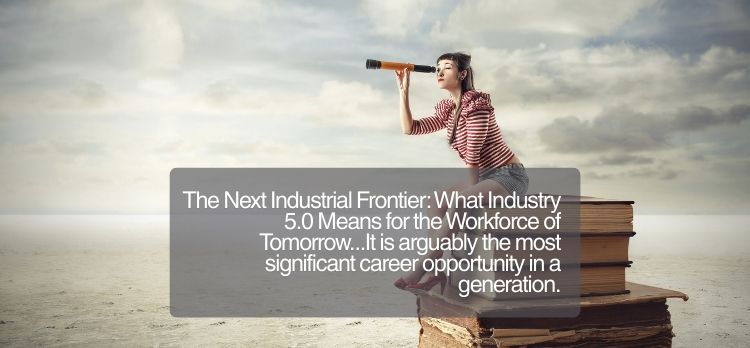
For graduates entering the workforce — particularly those trained in data science and management — this inflection point is not a threat. It is arguably the most significant career opportunity in a generation.
The European Commission's own Industry 5.0 framework, which has shaped much of the global policy discourse on the subject, explicitly calls for a workforce capable of merging analytical rigor with human judgment. A systematic review published in Production Planning & Control in 2025 found that human-centered AI in Industry 5.0 environments demands precisely the hybrid profile that data science and management programs are beginning to produce: professionals who can design intelligent systems, interpret their outputs critically, and translate technical insights into strategic decisions.
The skills gap is real and widening.
According to the European Commission's Futurium Industry 5.0 community, the revolution combining human creativity with AI, big data, and collaborative robotics requires businesses, investors, and regulators to collaborate in ways that traditional organizational hierarchies were never designed to support. Data science graduates who understand not just algorithms but also organizational behavior, change management, and stakeholder communication will find themselves in rare demand.
The sustainability dimension opens another frontier entirely. Industry 5.0's emphasis on circular economies and regenerative design, creates entirely new categories of data-intensive problems — from supply chain carbon accounting to predictive resource optimization — that require exactly the kind of interdisciplinary thinking that management education, combined with data fluency, is designed to cultivate.
None of this means the transition will be frictionless. The same technologies that promise to augment human potential also raise legitimate concerns about algorithmic bias, reduced worker autonomy, and the concentration of productivity gains among already-powerful firms. A 2025 study in Problems and Perspectives in Management found that in complex technical and strategic tasks, humans remain irreplaceable — but only when organizations invest deliberately in the personality skills the new era demands: analytical and creative thinking, emotional intelligence, and the ability to generate genuinely new ideas.
The industrial world is not short of technological ambition. What it is short of — and what the MIT Technology Review and EY research makes painfully clear — is the managerial discipline to translate that ambition into lasting, measurable, and equitably distributed value. For the data scientists and management graduates paying attention, that gap is not a problem to lament. It is a career to build.
Admissions Open - January 2026