
Why Process Thinkers Quietly Run Companies
Feb 27, 2026
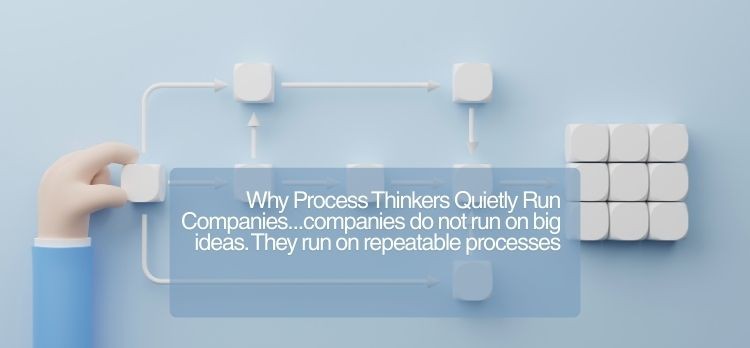
Behind every smooth company operation is someone who understands processes. Learn why this skill is becoming a silent career advantage.
When you join your first internship, the work rarely looks dramatic.
- You are updating a spreadsheet.
- Tracking leads in a CRM.
- Sending reminders.
- Reconciling numbers.
- Coordinating with another team.
It feels small. But here is what most early-career professionals miss: companies do not run on big ideas. They run on repeatable processes. And the people who understand those processes end up becoming the most valuable employees in the room.
What Is Process Thinking Exactly?
Process thinking simply means asking:
- What happens first?
- What happens next?
- Who is responsible?
- Where do things usually get stuck?
Imagine ordering food on a delivery app. Behind one click, there is a sequence: order confirmation, restaurant acceptance, kitchen preparation, delivery partner assignment, tracking, payment settlement. If any step breaks, the experience breaks.
Companies work the same way. Sales has a lead qualification process. HR has a hiring process. Finance has a payment approval process. Marketing has a campaign launch process.
According to McKinsey, companies that actively redesign and streamline processes can reduce operational costs by 20 to 30%. That is not a small improvement. That is the difference between profit and loss. Yet most students are trained to focus on tasks, not systems. Process thinkers focus on systems.
The World Economic Forum lists “analytical thinking” and “systems thinking” among the top skills employers want over the next five years. When you join as a management trainee or analyst, your job is often to execute someone else’s process. But your growth depends on how well you understand the whole chain.
Here is what usually happens in internships:
- You are told to generate a weekly sales report.
- You copy numbers from one tool into another.
- You send it to your manager.
Most interns stop there.
A process thinker asks:
- Where do these numbers come from?
- Why do we track these specific metrics?
- Who uses this report?
- Could this be automated?
Suddenly you are no longer just “doing the report.” You are improving the system.
In many companies, internal promotions happen not because someone works harder, but because they understand how different pieces connect.
Process Thinking is Primary for Early Career Professionals
You do not need to become a consultant or operations manager to use process thinking. It shows up in everyday software you already know.
In Excel, a messy sheet that requires manual correction every week is a broken process. In Google Sheets, if three people edit the same file and overwrite data, that is a coordination problem. In a CRM like Salesforce, if leads are not updated on time, sales forecasting becomes inaccurate. In a newsroom workflow, if data collection, verification and publishing are not sequenced clearly, credibility suffers.
Notice something important. None of this is about advanced AI. It is about clarity. Interestingly, AI is making process thinking more valuable, not less.
A 2023 PwC survey found that 73% of executives believe automation and AI will change how their companies operate within three years. But automation only works when the process is clearly defined. If you do not understand the steps, you cannot improve them. And if you cannot improve them, you remain replaceable.
First, start mapping processes in your current environment. Take one recurring task and write down every step from start to finish. You will immediately notice inefficiencies.
Second, learn simple workflow tools. Not coding. Just tools like Notion, Trello, or Zapier. These help you see how tasks move from one stage to another. Even understanding basic automation like “if this happens, then that happens” builds valuable thinking habits.
Third, ask better questions during internships. Instead of asking only what to do, ask how the work fits into the larger objective. Managers notice this difference quickly.
Fourth, build a small portfolio of improvements. If you streamlined a reporting sheet or created a checklist that reduced errors, document it. Recruiters love concrete examples of efficiency improvements.
Finally, connect process thinking with AI. If you understand the workflow, you can identify where AI tools like ChatGPT, data dashboards or automation scripts can save time. That makes you future-ready without being technical.
The real power of process thinking is simple. It shifts you from being a task executor to being a system improver. Companies quietly reward the people who reduce friction.
They are the ones who make things run smoothly. And over time, those people end up running the company.
Most students focus on skills. Few focus on systems. Process thinking is the quiet advantage that turns interns into leaders. If you want to stand out early in your career, start by understanding how work actually flows inside companies.
#CareerGrowth #ProcessThinking #PraxisBusinessSchool #AIandCareers #FutureSkills #ManagementStudents
Admissions Open - January 2026