
When Comics Meet Economics: How MIT Is Rewriting the AI Inequality Story
Dec 4, 2025
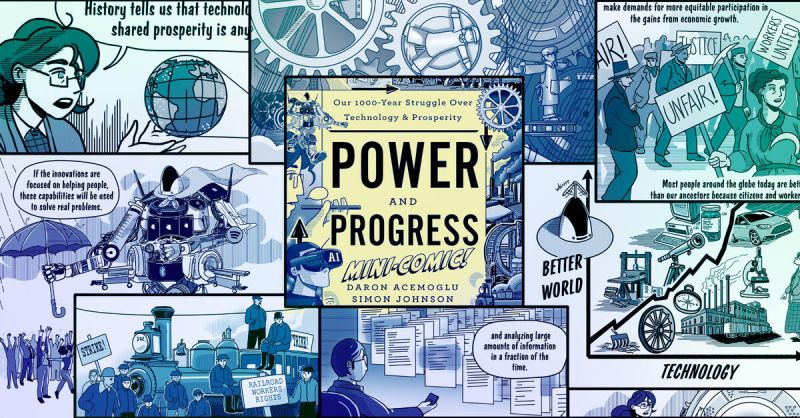
If you thought that venerable institutions like MIT and Nobel winner professors only produced dense research papers with lots of mathematical formulas, you are in for a shock. Two 2024 Nobel laureates have partnered with Boston University's Gutter Studios to transform complex economic arguments about AI and inequality into a visually compelling mini-comic—making urgent truths about technology's unequal impact accessible to everyone. In the process, they have made an audacious advance in research communication, pioneering a novel approach to scientific writing that bridges the intellectual chasm between researchers and the general populace.
Daron Acemoglu and Simon Johnson, along with their collaborator James Robinson, won the Nobel Memorial Prize in Economic Sciences "for studies of how institutions are formed and affect prosperity." Their groundbreaking mini-comic Power and Progress: The Mini-Comic! challenges the widespread techno-optimism surrounding AI by exposing a darker reality: without deliberate intervention, AI threatens to deepen inequalities by empowering elites at the expense of workers whose jobs are being automated. MIT's 'Power and Progress' mini-comic creatively explains AI's societal impact and economic inequalities using engaging illustrations and dialogue
A Bold Communication Strategy
The mini-comic, developed in collaboration with Boston University's Visual Narrative MFA program and created by acclaimed cartoonist Joel Christian Gill, transforms complex economic arguments into an engaging dialogue between Polly, a robot, and Daisy, a historian. This innovative partnership between MIT's Stone Center on Inequality and Shaping the Future of Work and BU demonstrates how institutions are rethinking knowledge transfer in the digital age.
As Acemoglu and Johnson explain in their 2023 book Power and Progress, "the direction of technology and who benefits depend on the choices of those controlling it, not some predetermined path of technology we can't control." This central thesis forms the philosophical backbone of the comic, which uses historical examples—from Jeremy Bentham's panopticon to the Industrial Revolution—to demonstrate that technological progress has never automatically led to shared prosperity.
History's Cautionary Tale
The comic revisits Jeremy Bentham's 1791 panopticon, a circular prison design symbolizing oppressive surveillance. As the comic illustrates, "Bentham's vision was that surveillance in factories would induce workers to labor harder, without needing to pay them higher wages to motivate greater effort." The design was quickly applied to factories, enriching owners at the expense of workers. One weaver quoted in 1835 laments: "No man would like to work in a power-loom, they do not like it, there is such clattering and noise it would almost make some men mad."
This historical parallel demonstrates that promises of efficiency and progress have consistently been used to justify systems concentrating wealth among elites while degrading working conditions for the majority. The comic emphasizes: "most people around the globe today are better off than our ancestors because citizens and workers in early industrial societies organized, challenged elite-dominated choices about technology, and forced ways of sharing the gains from technological improvements more equitably."
The AI Dilemma: Automation Versus Augmentation
The comic explores what Acemoglu calls "so-so automation"—technologies that displace workers without generating significant productivity gains. Examples include automated customer service systems that frustrate customers while eliminating jobs, or self-checkout kiosks that shift work to consumers without improving efficiency.
The comic illustrates: "A.I. could automate jobs, just like the computer revolution did for jobs in data entry, customer service, and administration." More troublingly, "it might contribute to job market polarization where middle-skill jobs are automated, 'hollowing out' middle-skill opportunities and leaving more workers in low-paying jobs."
Crucially, the comic contrasts this with pro-worker technology. Between 1945 and 1975, wages rose for workers at all skill levels in the United States. "Electrification in the US raised productivity while creating plenty of new jobs and new opportunities for workers." Similarly, "pioneers invented computers as a tool to augment human intelligence and creativity, not replace it," creating "new tasks that increase demand for workers with expertise."
However, "from 1980, the digital revolution has boosted the earnings of highly educated workers and squeezed the middle class," with "real wages for people with only a high school education" barely increasing "in the past 40 years."
The Path Forward: Pro-Worker AI
The mini-comic explores what Acemoglu and Johnson call "pro-worker AI"—technologies designed to augment rather than replace human capabilities. "Pro-worker A.I. could be steered towards creating new tasks, providing better information, and building platforms of collaboration."
However, as the comic warns, "this is not the direction we are headed in." The current trajectory is heavily biased toward automation and labor displacement rather than augmentation. The comic explains: "confronting the prevailing vision and wresting the direction of technology away from the control of a narrow elite may be even more difficult today than it was in 19th-century Britain and America. But it is no less essential."
Acemoglu and Johnson's recommendations include rebalancing tax incentives that favor automation over human labor, investing in research prioritizing human-complementary technologies, strengthening worker organizing and collective bargaining, and creating regulatory frameworks ensuring AI development serves broad social interests.
Why a Comic?
The choice to adapt economic arguments into comic form reflects MIT's recognition that academic papers alone cannot reach the audiences who need this message most. Cartoonist Joel Christian Gill emphasizes that comics have "the unique ability to manipulate meaning by changing the two fundamental components of words and pictures and merging them together," making abstract concepts tangible and policy arguments emotionally resonant.
This collaboration between MIT economists and BU's Visual Narrative program represents what scholars call an "explosion of comics" being used for education and social commentary. Comics are increasingly recognized as a sophisticated medium capable of addressing complex, adult-oriented subjects.
The comic's central message resonates urgently as AI capabilities rapidly expand: "We need counter-balancing forces which promote the interests of workers and push back on tech powers." Yet the comic also offers hope. History demonstrates that when workers organize, when democratic institutions function, and when technology is deliberately steered toward augmenting rather than replacing human capabilities, shared prosperity is possible. By translating their Nobel Prize-winning insights into an accessible comic format, Acemoglu and Johnson have shown that the future of AI is not predetermined—and that we retain the power to shape it.
Admissions Open - January 2026