The AI Workslop Threatens Productivity Gains
Feb 7, 2026
A troubling phenomenon has emerged, as AI tools get embedded in our workflow, that threatens to undermine the very productivity gains these technologies promise. Workslop—those deceptively polished but cognitively hollow outputs generated with minimal human effort—has become a quiet crisis in organizations everywhere, breeding mistrust and corroding the collaborative energy that makes teams thrive. For data scientists and managers preparing to navigate this landscape, understanding the systemic forces behind workslop isn't just academic; it's essential for building sustainable, high-performing organizations that actually benefit from AI rather than drowning in its sludge.
The Rising Costs of Workslop
Recent research surveying 1,150 full-time employees across industries reveals that 41% can recall specific instances of workslop that directly derailed their work, with each incident costing nearly two hours in rework and corrections. Even more revealing, 53% of respondents admitted to sending subpar AI-generated work to colleagues, with one in ten confessing that half or more of their AI-assisted output was unhelpful, low-effort, or simply low quality.
This creates a paradox that the Federal Reserve Bank of St. Louis has quantified: while AI users report saving 5.4% of their work hours—about 2.2 hours per week—these individual gains translate to only a 1.1% increase in aggregate productivity across organizations. That gap represents the hidden cognitive tax of verifying, correcting, and compensating for workslop, a burden that falls squarely on recipients who must now shoulder the mental labor that senders have offloaded.
More Defects Than Human Code
A 2025 study analyzing 470 open-source GitHub pull requests found that AI-generated code contains 1.7 times more defects than human-written code across every quality dimension. Logic and correctness issues increased by 75%, while performance inefficiencies appeared nearly eight times more frequently in AI-assisted submissions. These aren't abstract statistics; they reflect real workplace breakdowns.
At one technology company, the practice of "vibe coding"—where developers lean heavily on AI generation without thorough review—created scores of critical bugs that pushed a senior engineer to resign with just two days' notice. The pattern extends beyond software. A qualitative researcher described feeling "gaslit" after their manager ran research findings through ChatGPT to generate tables and discussion sections, producing incorrect results and jargon-filled nonsense. The violation wasn't just the wasted time, but the unauthorized use of their work and the erosion of methodological integrity that defines credible data science.
Eroding Trust
What makes workslop truly insidious, however, is how it corrodes the human relationships that organizations depend on. Edelman's 2025 Global Trust Barometer documented an unprecedented three-point decline in employee trust in employers, while BetterUp's dataset of over 400,000 employees showed a 2-6% decline since 2020 in foundational performance mindsets like focus, agility, and strategic planning.
This erosion creates a vicious cycle: when employees lose trust, they engage in protective behaviors that degrade AI training data and performance, which further erodes trust. The psychological research reveals distinct trust configurations among employees, from full trust to blind trust, each triggering different protective or destructive behaviors. Dale Carnegie's 2025 research reinforces this dynamic: 68% of employees who trust leadership, understand AI, and receive soft skills training are extremely positive about AI changes, compared to just 21% of others. The gap between these groups isn't about technical skill—it's about whether people feel safe admitting uncertainty, raising concerns about quality, and asking for feedback without stigma.
Yet workslop isn't a failure of individual competence; it's a management failure. Forty-one percent of employees report that leadership encouraged AI use without providing detailed instructions or the contextual understanding needed for meaningful application. This reflects what McKinsey calls the "AI maturity gap": while nearly all companies invest in AI, only 1% believe they've reached maturity in implementation.
The pressure originates from boards who view AI as a lever to compensate for slowing productivity, pushing executives to demonstrate ROI through blunt mandates rather than strategic integration. Frontline employees face what BCG terms a "silicon ceiling"—only half regularly use AI tools despite organizational mandates because they lack clarity on appropriate use cases.
This environment has created a motivation paradox that's particularly relevant for management students. While AI tools demonstrably increase output quality and speed, they simultaneously degrade intrinsic motivation. A study of over 3,500 employees found that after using generative AI for writing and analysis tasks, motivation dropped by 11% and boredom increased by 20% when returning to non-AI work.
This "AI exhaustion" compounds existing burnout—employees now face 13 enterprise-wide changes per year, five times more than eight years ago, with 75% of HR leaders reporting manager overwhelm. The cognitive science explains why: when AI handles mentally demanding components, ordinary work feels less stimulating, reducing the dopamine rewards associated with problem-solving.
The Three-Level Solution
Addressing workslop requires moving beyond individual blame to systemic solutions across three levels. First, cultural infrastructure matters profoundly: our analysis shows that trust in one's team reduces workslop by 61%. Leaders must rebuild trust through transparency, modeling their own AI experiments and failures, normalizing peer review processes specifically for AI-assisted work, and investing in soft skills training that strengthens communication and critical thinking. Second, practice design must create agency: employees with a sense of competence and control over AI tools are half as likely to create workslop. This means defining quality standards explicitly for different roles, forward-deploying AI engineers to help teams integrate tools meaningfully into workflows, and establishing review checkpoints that require human validation before sharing
Third, accountability structures need a new hybrid role—what we might call Forward Deployed AI Collaboration Architects—who bridge technology and human needs by mapping workflow friction, designing AI interventions aligned with employee motivations, and connecting AI strategies to measurable outcomes beyond mere usage metrics.
Technical Rigor Can’t be Outsourced
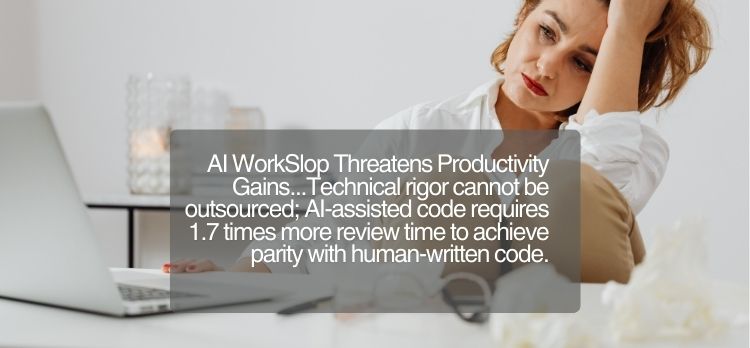
For students of data science and management, the implications are clear. Technical rigor cannot be outsourced; AI-assisted code requires 1.7 times more review time to achieve parity with human-written code. Methodological integrity is at risk when data is run through AI without understanding statistical assumptions, potentially producing jargon-filled nonsense that damages professional credibility. Transparency becomes an ethical obligation, not just a best practice—documenting AI assistance in workflows builds trust and enables reproducibility.
For future managers, mandates without training are counterproductive; 68% of AI projects remain in pilot stage because organizations fail to address integration complexity. Measuring outcomes rather than usage is critical—tracking adoption rates incentivizes performative behavior, while measuring downstream quality metrics and team trust levels drives real improvement. And perhaps most importantly, psychological safety is a prerequisite for successful AI adoption; without trust, employees engage in behaviors that corrupt both AI systems and team culture.
Source: Original concept and research from "AI-Generated 'Workslop' Is Destroying Productivity" by Jeff Hancock, Kate Niederhoffer, and Alexi Robichaux, Harvard Business Review, September 2025. This adaptation incorporates additional research and industry data to contextualize the phenomenon for data science and management education.[hbr]
Admissions Open - January 2026