
The AI-Coworker Era Has Begun
Mar 6, 2026
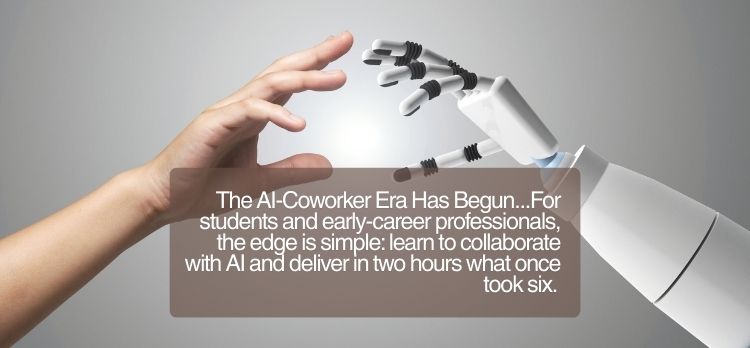
A new class of AI is moving from answering questions to working alongside you on real tasks inside companies.
Until recently, most AI tools felt like smart search engines. You asked a question. They replied with text. Anthropic’s Claude Co-Work changes that idea.
Instead of being a chatbot you occasionally consult, it acts more like a junior colleague. It can read long documents, draft structured reports, analyze spreadsheets, summarize meetings, generate code and revise work based on feedback. And it does all of this inside your workflow.
Claude is not alone either.
Perplexity AI too recently introduced the ‘Perplexity Computer’. While Claude focuses on being embedded inside company workflows, Perplexity Computer focuses on something equally powerful: turning AI into a research operator that can browse the web, synthesize sources and produce structured outputs almost like a trained analyst.
To understand why this matters, we need to step back.
The AI-Coworker Era
Claude Co-Work builds on models developed by Anthropic. Think of it as an AI assistant designed to operate inside work tools, not outside them. Imagine this scenario: you are an intern at a consulting firm. You receive:
- A 60-page client deck
- Three Excel sheets
- Notes from two meetings
- An email asking for “key risks, revenue drivers and next steps”
Normally, this would take you hours. You would read, highlight, extract, cross-reference and structure. Claude Co-Work can do the first draft of that thinking in minutes. It reads across documents, identifies themes and produces a structured summary. You then review, refine and improve it. Co-Work replaces grunt work with more time for your judgement. That shift is critical.
McKinsey estimates generative AI could add $2.6 to $4.4 trillion annually to global productivity. A large share of that value comes from tasks like drafting, analyzing, summarizing and coding. Not from replacing CEOs. From speeding up everyday knowledge work. That is why this matters – entry-level roles are full of exactly those tasks.
Now imagine a different situation. You are working in a strategy team. Your manager says, “Give me a competitive landscape of India’s EV battery market. Include funding rounds, policy tailwinds and risks.”
This goes far beyond internal document analysis. This is exactly the kind of open-ended research tasks Perplexity Computer has been designed for. It does not just answer with a paragraph, it browses the web in real time, reads multiple sources, compares claims and generates structured outputs with citations. Think of it as an AI research assistant that:
- Searches across live web sources
- Cross-verifies claims
- Compiles structured reports
- Can continue refining outputs based on follow-up instructions
Instead of spending four hours jumping between Google tabs, PDFs and news articles, you could compress the first pass of research into minutes. For early-career professionals, that changes the equation. Research-heavy roles in consulting, equity research, policy, marketing and journalism all rely on information synthesis. Tools like Perplexity Computer automate the mechanical part of that process.
Your job becomes asking sharper questions and judging better answers.
For the Entry-Level Aspirant
If you are an early-career aspirant preparing for internships or your first role, your first jobs will likely involve:
- Research and note-making
- Building presentations
- Cleaning data in Excel
- Writing internal summaries
- Drafting emails and reports
- Updating CRM systems
- Basic coding or automation
These are high effort, medium skill tasks. AI coworkers are optimized for them.
Goldman Sachs estimated that AI could affect 300 million jobs globally. That headline sounds scary. But the more important insight is this: most roles will not disappear. They will change. Your productivity baseline will shift.
In the past, being good at PowerPoint or Excel made you stand out. Soon, being good at working with AI inside those tools will matter more. For example:
Instead of manually creating charts in Excel, you might ask AI to:
- Identify outliers
- Suggest visualizations
- Explain trends in simple language
Instead of drafting a report from scratch, you might:
- Provide bullet points
- Ask AI to structure it
- Edit for tone and accuracy
The student who knows how to collaborate with AI will finish in two hours what once took six. Managers will notice.
Markets Have Reacted Strongly
So what should you do now? First, stop thinking of AI as a shortcut. Start treating it as a productivity multiplier. Here are concrete steps:
- Use AI to summarize long PDFs and compare the output with your own summary. Study the gaps.
- Use Perplexity Computer to generate a research brief on an industry, then fact-check every citation.
- Practice turning messy meeting notes into structured reports using AI tools.
- Learn prompt writing as a practical skill. Be specific about format, tone and constraints.
- Build small workflows. For example, extract insights from survey responses using AI, then present them in PowerPoint.
- Always verify numbers and claims. AI can still produce confident mistakes.
Second, build basic data fluency. While you do not necessarily need to code deeply, you should definitely understand:
- How spreadsheets work
- What structured versus unstructured data means
- How automation tools connect apps
Finally, position yourself as someone who increases team productivity. In interviews, instead of saying “I know ChatGPT,” say: “I built a workflow where AI summarized customer feedback and reduced reporting time by 40 percent.”
That subtle shift in language signals value.
AI coworkers like Claude Co-Work and research operators like Perplexity Computer are early versions of a new software category. The question is not whether they will enter your workplace. It is whether you will know how to work alongside them.
Claude Co-Work drafts, summarizes and analyzes inside your company’s workflow. Perplexity Computer researches, verifies and structures insights across the web. Together, they turn AI from a tool you ask questions to into a teammate that helps you execute.
For students and early-career professionals, the edge is simple: learn to collaborate with AI and deliver in two hours what once took six. Less busywork. More judgment. More impact.
#AI #Careers #PraxisBusinessSchool #FutureOfWork #GenerativeAI #Students #Productivity #BusinessTechnology
Admissions Open - January 2026