
What AI-Native Leadership Means for Agentic Management
Dec 6, 2025
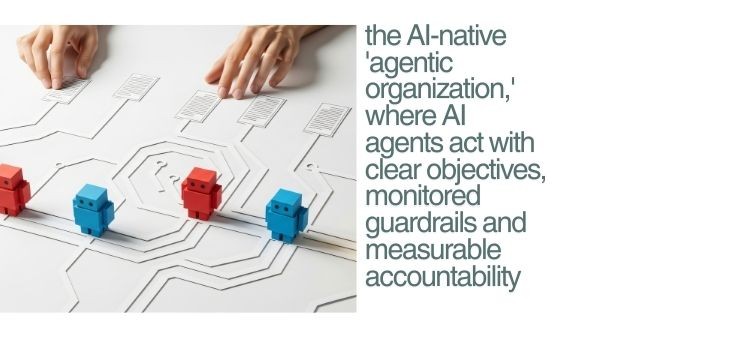
AI-native leadership demands a new management logic in which leaders design organizations that think, learn, and act alongside autonomous AI systems.
Most organizations know how to adopt technology, but very few know how to redesign themselves around it. AI-native leadership signals a shift in how firms think about talent, structure and learning. Leaders today must craft environments where autonomous systems participate meaningfully in decisions, execution and knowledge building, moving far beyond the existing paradigm of simply incorporating new tools into workflows. This shift introduces a new organizational form: the 'agentic organization,' where AI agents act with clear objectives, monitored guardrails and measurable accountability.
Traditional digital transformation focused on efficiency: better analytics, smoother workflows, tighter integration. AI-native leadership operates at a different altitude. It focuses on organizational cognition. Leaders identify which decisions require human judgment, which can be supported by AI and which can be executed by AI agents entirely. This division of work is about creating a structure where the firm’s decision-making capacity expands faster than its headcount.
Why AI-Native Leadership Emerges Now
Three forces push organizations toward this new model:
- First, large language models allow reasoning and interpretation at speeds that match or exceed human processing in specific domains.
- Second, agent frameworks let AI systems interpret goals, track progress and adapt to new information.
- Third, enterprises now treat knowledge as a strategic asset, far more valuable than a static repository. AI systems can continually refine, synthesize and operationalize knowledge in ways that outpace traditional knowledge-management approaches.
AI-native leaders understand these forces and respond by shaping governance structures, talent models and workflows that accommodate non-human actors. They ask how the organization should evolve when its most tireless knowledge worker never sleeps and improves continuously.
An agentic organization assigns responsibility to AI agents the same way it assigns responsibility to teams or functions. Agents manage defined tasks such as summarizing customer signals, monitoring risk exposures, preparing competitor intelligence or managing aspects of a supply chain. They escalate exceptions, learn from new data and align themselves with organizational priorities.
Importantly, an agentic organization is not leaderless. Leaders remain accountable for the architecture, oversight and ethical framing of AI systems. They shape the 'rules of engagement' between humans and agents. They ensure that an AI system that prepares forecasts does not also approve credit decisions without explicit governance. Leadership evolves from directing tasks to designing systems of distributed intelligence.
Skills for AI-Native Leadership
While AI-native leaders do not necessarily need to develop deep technical expertise, they must understand how AI extends organizational capability. Three skill clusters stand out:
- Architectural thinking: Leaders must understand how data, processes and decision rights interact. They design workflows where human strengths, such as context, empathy and judgment fit alongside AI strengths such as pattern recognition and large-scale synthesis.
- Interpretive competence: AI systems generate insights, but leaders validate relevance, evaluate risks and interpret signals within strategic horizons. They focus on quality of reasoning, not just quality of output.
- Adaptive governance: Rules evolve as capabilities evolve. Leaders build governance systems that track model performance, data provenance and ethical boundaries. Governance becomes a living process.
Agentic organizations tend to move faster because intelligence is distributed. Decision bottlenecks are reduced. Knowledge accumulation accelerates. Teams have more time for strategic thinking because routine monitoring, summarization and first-draft generation move to agents.
At the same time, new risks emerge – over-reliance, model drift, opaque decision paths. Performance gains remain sustainable only when leadership treats AI as a dynamic capability. Leaders monitor how agents behave, how they learn and how their actions influence organizational outcomes. Better AI does not automatically produce better decisions. Well-designed leadership systems do.
Students Today, Leaders Tomorrow
For management students, the rise of AI-native leadership shifts expectations. Graduates entering tomorrow’s firms will work alongside autonomous agents as naturally as earlier cohorts worked with spreadsheets. Skills in prompt design, data literacy and critical evaluation of AI-generated intelligence become foundational. Strategy work demands understanding how agentic systems reshape industries and competitive boundaries. The best leaders of the next decade will be those who treat AI as a partner in designing the next generation of organizations.
Schools that train students to blend managerial judgment with AI fluency create a distinctive advantage. Praxis’s emphasis on analytics, decision-science and applied technology places its graduates at the frontier of this leadership shift. The coming decade will reward leaders who can interpret ambiguous environments, design adaptive systems and align humans and AI into a cohesive organizational rhythm.
#AI #ArtificialIntelligence #AINativeLeadership #AgenticOrganizations #FutureOfWork #PraxisBusinessSchool #DecisionScience #AILeadership #OrgDesign #DigitalStrategy #ManagementEducation
Admissions Open - January 2026